Herbicide-resistant weeds are a multimillion-dollar problem for Alabama cotton growers. New research will examine how two widely used pre-planting practices – poultry litter application and cover crops – affect weed emergence. The study will define best management practices that keep the benefits of poultry litter and cover crops without unintentionally growing weeds or reducing herbicide effectiveness.
A team of weed scientists from the Alabama Agricultural Experiment Station was awarded $294,000 by the National Institute of Food and Agriculture to study integrated weed management. The project aims to fine-tune weed management systems, rather than abandon the two practices that offer important economic, agronomic and environmental benefits.
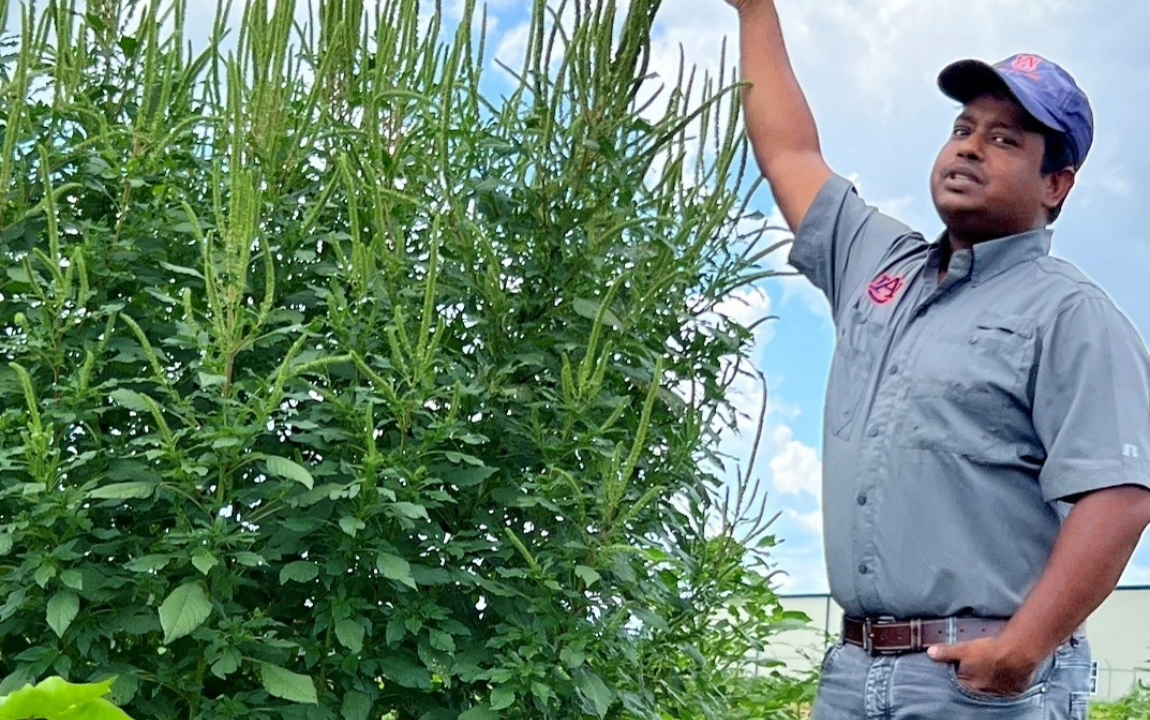
“This is about refinement, not replacement,” said Aniruddha Maity, assistant professor of weed science and the leader of the AU Weed Bionomics Lab. “We want to help farmers keep the tools they value while improving weed control and reducing costs.”
Alabama cotton and cottonseed is valued at $271 million, according to USDA’s National Agricultural Statistics Service. Alabama is the 7th highest cotton-producing state. It’s grown in 60 of Alabama’s 67 counties.
Since the mid-2000s, farmers have increased the use of expensive herbicides by 30% per hectare, largely to address herbicide-resistant weeds commonly found in cotton fields. Farmers today must apply herbicide more frequently and use a greater variety of herbicides to overcome the resistance that’s developed in recent decades.
“Much like our own antibiotic resistance, you cannot get well with only one medication. You need multiple medications. It’s the same with weed control. You can’t control your weeds with only one or two chemicals. Now you need this chemical for these weeds and that chemical for those weeds. Now you’re using five chemicals per season and spending tons of money,” Maity said.
Weed control costs have skyrocketed in recent decades. Nationwide, weed control in agriculture costs $6 billion annually, according to USDA estimates. The researchers hope to put a dent in these costs by improving herbicide practices.
One focus of the research addresses cover cropping, which has been increasingly adopted for its soil health, erosion control and early-season weed suppression benefits. However, while a dense cover crop can suppress weed emergence, it can also prevent pre-emergent herbicides from reaching the soil, which they must do to be effective. This means farmers must apply greater amounts of herbicide or repeat applications to overcome the barrier presented by the cover crop.
Maity’s research will study how much herbicide is intercepted by cover crops versus how much reaches the soil, as well as how rainfall affects activation and effectiveness. Maity will also experiment with additives that will improve application, ultimately establishing the optimal dose for herbicide application to dense cover crops.
The second focus is on poultry litter’s (PL) effect on weed growth. Poultry litter is a popular source of fertilizer in Alabama. It’s cheap, local and the state’s poultry industry produces 3.6 billion pounds of it each year. Because birds are so good at digestion, the litter has the added benefit of not containing weed seeds.
However, somewhat controversially, anecdotal evidence shows PL seems to promote weed emergence in some crop fields. Maity and the research team will study this claim scientifically in greenhouse and field trials. Maity has several theories as to why PL might lead to more weeds. The first is simply that a rush of nutrients from PL might encourage existing weed seeds to germinate at once.
“It’s a sudden flow of nutrients because poultry litter doesn’t have a mechanism to hold back the nutrients [as with a time-release fertilizer],” Maity said. “Once there’s rainfall or irrigation, it releases all the nutrients at once.”
Another theory the research team will test is that organic acids and microbial populations inherent in PL help to break down a seed’s coating in the soil seedbank, which encourages it to sprout. The researchers will examine how application timing, rate and PL formulation affect weed growth and herbicide performance in cotton fields.
The project builds on several years of preliminary research conducted at Auburn University, and includes collaboration with nutrient management specialists, cover crop researchers, industry partners and Extension specialists.
In addition to Maity, Andrew Price, Rishi Prasad and Rakesh Kumar Ghosh were also part of this research grant.