
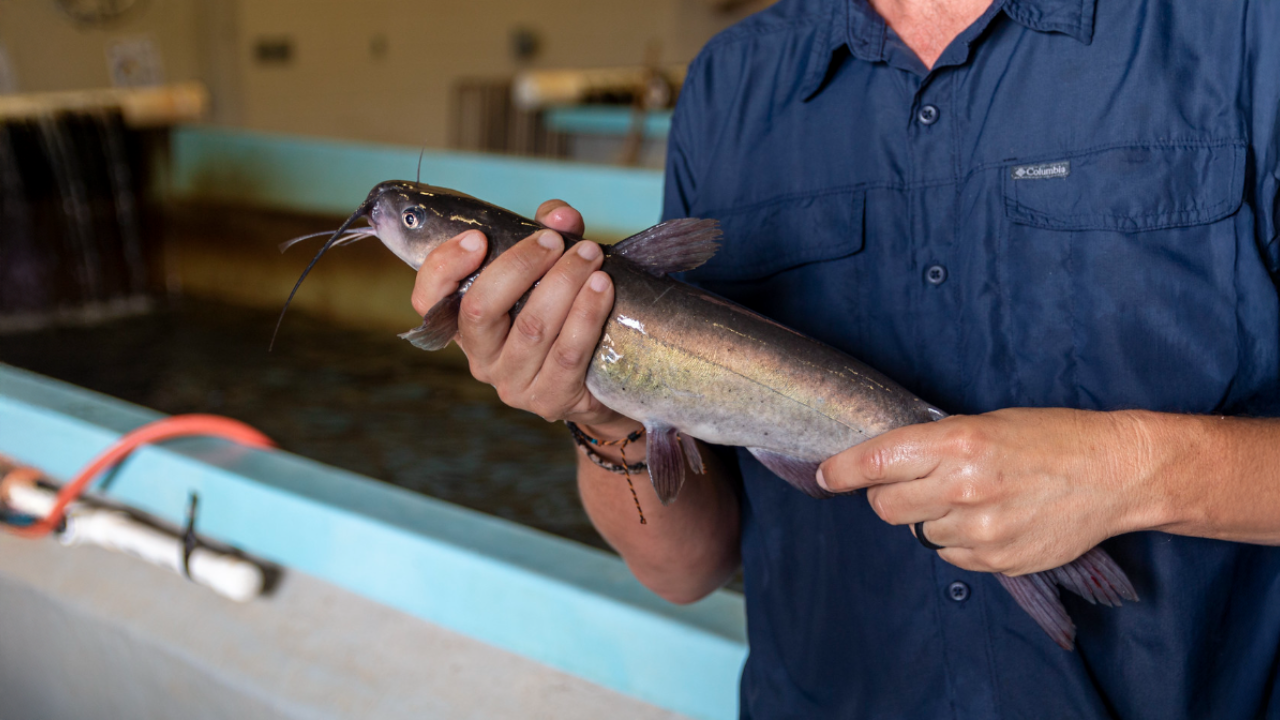
Fish scientists at Auburn University have recently refined a gene replacement method for transferring a advantageous gene from alligators into catfish to increase disease resistance. The method purposefully makes the fish sterile by replacing a reproductive gene with the alligator gene, requiring hormone therapy for these transgenic catfish to reproduce. The team’s research has developed better therapies to make transgenic fish more fertile.
Transgenic catfish are made sterile to control their reproductive capacity, thereby mitigating the risk of a transgenic fish establishing a wild population. This research is made possible by a $649,999 grant from the USDA’s Biotechnology Risk Assessment Research Grant program.
“The ultimate goal is to simultaneously increase disease resistance, increase the growth rate, increase the fatty acid levels, and make them sterile, but in a way that we can rescue the fertility,” Dr. Dunham said.
The desired outcome is to benefit consumers by using science to develop cheaper American grown fish and fishery products. The U.S. is one of the largest importers of fish and fishery products, resulting in a $17 billion dollar trade deficit.
The transgenic catfish study applies the knock-in (KI) and knock-out (KO) method to produce the modified fish. In other words, researchers can gain and lose functions when targeting specific genes within the fish. Auburn researchers have utilized this process to remove the reproductive gene in the catfish. However, this requires transgenic catfish to go through hormone therapy to be able to reproduce.
Compared to any previous approaches, the sterile fish leave little risk to the environment and come with considerable potential for the future use of transgenic catfish.
“If they were to escape, or intentionally stocked into the environment, they’re not able to reproduce,” said Dunham.
Dunham and his team of scientists are currently evaluating the functional impacts of the past season’s transgenic fish, also known as the analysis phase. To prepare for the next phase of research, the team will continue to modify each generation until the results are consistent enough for commercialization.
“We’ve done the first series of treatments and take the best ones from that first round and by next year, next spawning season, tweak those to see if we can improve them further,” Dunham said.
Alligator genes are another component of this innovative process; the genes improve the fish’s resistance to disease.
“Alligators are highly resistant to pathogenic bacteria; they can fight with each other, they lose limbs and they don’t get infected,” said Dunham.
According to Dunham’s report, the research has successfully shown that there is a “30-60% increased growth rate, almost a doubling in n-3 fatty acid levels, increased disease resistance as well as genetic sterilization.”
Looking ahead, the team will continue to refine the transgenic research to assure there are no unfavorable effects on the traits of the transgenic catfish and to improve the hormone therapy.
The research trials are being conducted at Auburn University’s large-scale 1600- acre E.W. Shell Fisheries Center. The facility is not the only aspect of the trials that bolsters the outcome of the research.
Auburn University is known as the leading fish genetics research program in the United States, particularly for catfish. Having a history of transgenic fish research, Auburn University continues to optimize their research since being the fourth in the world and first in the U.S to develop a transgenic catfish.
The research was led by Rex Dunham, Baofeng Su, Jinhai Wang, Rhoda Simora and Tim Bruce.
Written by Danielle Lunny