The Animal Science and Forages team at Auburn University is making an impact not only in Alabama but increasingly on a global scale through their research and outreach efforts. Through a multi-state research grant, the team is taking their research into Alabama cattle operations and beyond.
In this collaborative initiative, Auburn University, Clemson University and University of Florida are working together to analyze the effects of livestock feeding and greenhouse gas emissions. By pooling expertise and resources, the team is accelerating progress that no single institution could achieve alone.
At just under $1 million funding, this multi-year project conducts research through the Alabama Agricultural Experiment Station. Ultimately, the research aims to strengthen both environmental and practical outcomes for livestock operations.
Associate professor and Extension Specialist Leanne Dillard and assistant professor Brandon Smith of the Department of Animal Sciences co-lead the project.
“In the past, we have not measured enteric —methane produced during digestion —methane emissions like this,” Dillard said. “Working with our fellow land-grants, and even our own campus partners like the Chemistry department we can expand our impact.”
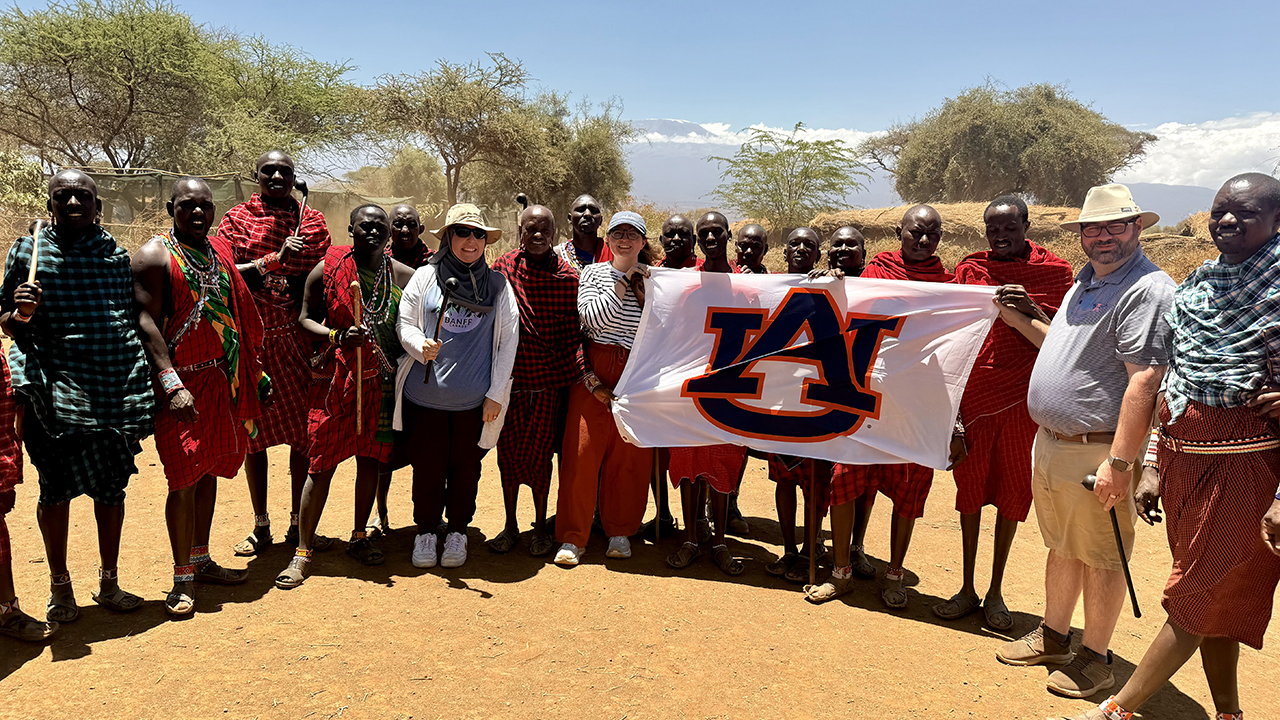
But this grant research extends its reach far beyond the Southeast; it stretches from here to the other side of the world. From Auburn, Alabama, to Nairobi, Kenya, the research team gained a deeper understanding for how beef production differs worldwide.
Dillard and Smith participated in the Greenhouse Gas & Animal Agriculture Conference in Nairobi, Kenya. The trip also opened doors for future collaborations with researchers and producers working in vastly different environments.
“An impressive part of African cattle production to me is the resourcefulness and resilience of their people,” Dillard said. “While they are always looking for ways to improve, it’s critical to them that they maintain cultural traditions, too.”
With countries represented from all over the globe, the Animal Science and Forages team had the opportunity to collect valuable insights.
Assistant professor and Alabama Extension Specialist Maggie Justice also attended the conference and said she learned a lot about African cattle production.
“It is incredible, the diversity of cattle production from one state to another, and even more so from one continent to the next,” Justice said. “The group in Africa was excited to discuss especially beef production with our group because they primarily have dairy production.”
The primary goals of this project are to improve sustainability and feed efficiency in cattle systems. In response to these challenges, the researchers are working to develop feed additives to help reduce methane output from grass-fed cattle.
The project will test increasing amounts of newly developed feed additives, moving forward with the best performance. Research teams at Auburn, Clemson and Florida will work together on this effort. Cattle growth will be measured and confirmed during on‑farm trials.
As part of this collective, each university is taking on a specific role. Together, they are working to uncover the true effects of the greenhouse effect as it relates to carbon dioxide and methane outputs.
“In Alabama, our focal point of this project is to analyze the cow-calf production stage since that is mainly how our producers operate,” Smith said. “Looking at our forage fed beef, and our grain fed beef we will be able to see a clearer picture of how we can improve.”
Having the luxury to utilize forages or grains as nutrition sources for cattle gives Alabama producers an advantage not always seen in other states or countries. With these options, Alabama cattle operations are able to fine-tune strategies for optimal feeding management.
New in her role, Justice said she is optimistic about the future of this research. She is making plans to learn with the producers and search for answers that keep the cattle industry moving forward.
“It hypes me up to step into this role and talk about the footprint our systems leave on the environment,” Justice said. “I think we’ll be surprised to learn it’s not as dire as we assume — and to see the ways we can keep improving.”
From Auburn to Africa, the team gained new perspectives by studying cattle systems shaped by diverse climates, management practices and cultural traditions. These insights will later reach producers through Extension outreach and educational programs.
As this project unfolds, the Animal Science and Forages team continues to join forces with fellow partners. These partnerships are important to not only improve cattle production but also bolster our environmental stewardship.