Auburn University’s Board of Trustees has approved the construction of four new support buildings for the Alabama Agricultural Experiment Station, the first such facilities built since the Tennessee Valley Research and Extension Center was completed in 2012.
“These new facilities expand the Experiment Station’s reach where it matters the most — out in the field and communities throughout Alabama,” said Arthur Appel, interim dean of the College of Agriculture and interim director of the Alabama Agricultural Experiment Station. “They represent a continued investment in agricultural research and outreach opportunities these outlying units will provide to the state.”
The board previously approved the recommendation of JMR+H Architecture of Montgomery as the architect for the overall project.
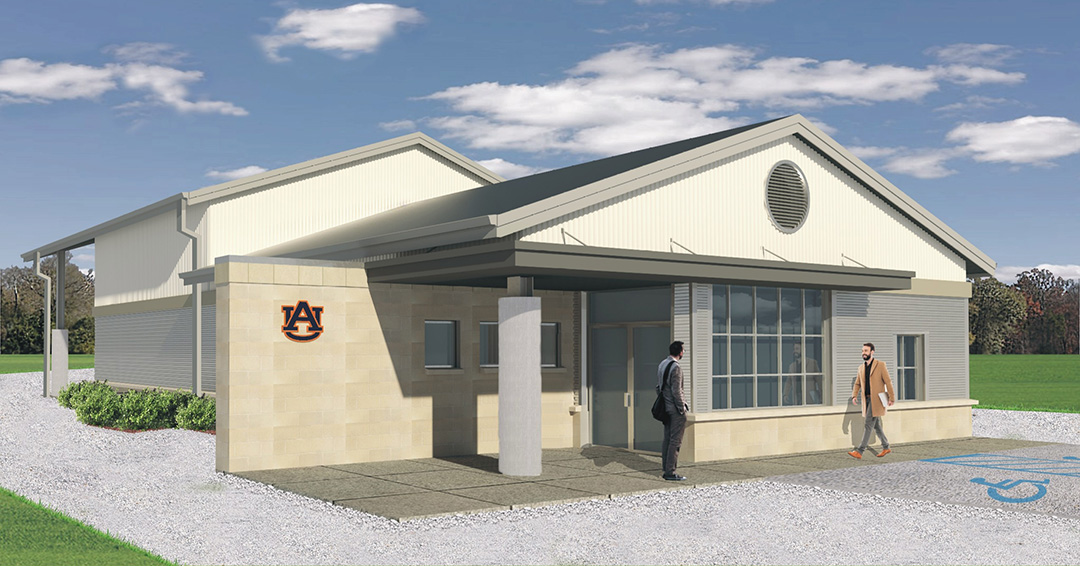
Each facility will consist of 2,500 square feet and is planned for construction at the E.V. Smith Research Center in Shorter, Brewton Agricultural Research Unit in Brewton, Autaugaville Research Center in Autaugaville, and the Chilton Research and Extension Center in Clanton.
Each facility has been designed to be an office and multi-use building that can be easily customized as research demands, said Greg Pate, director of research operations for the Experiment Station.
“The new Autaugaville Research Center will focus on row crops research, while the Brewton Research Center and the E.V. Smith Research Center Plant Breeding/Horticulture units support both row crop and horticultural research,” Pate said. “The Chilton Research and Extension Center focuses solely on horticultural research.”
The Autaugaville property, purchased in 2024, marks the Experiment Station’s first new outlying unit investment in 52 years. The site features 400 acres of cropland and 500 acres of woodland and will become a specialized center for expanded row crop and irrigation research in central Alabama.
“We plan to complete the building of facilities at Autaugaville in 2026 and early 2027,” Pate said. “There are two additional buildings required for the move. One will house the equipment shop and storage with another for chemical containment and fill-up. If everything proceeds on schedule, we should begin research in the summer of 2027.”
The new facilities are purposefully generic in nature to allow for customization as needed. The Autaugaville Research Center will incorporate elements for irrigation research that are not currently in the Experiment Station system.
The new buildings are unique to the current ones in that they will have dedicated space for sample prep and processing. The Chilton facility also will have a walk-in cooler for produce handling and storage.
The new Autaugaville facility, Pate said, will replace the Prattville Research Center. The Chilton Research and Extension Center will add an additional building to its inventory while the new facilities at Brewton and the E.V. Smith Plant Breeding Unit will replace current buildings that will be torn down.
“Each new building is estimated at $1.5 million each for a total of $6 million,” Pate said. “Three of the buildings, along with the land purchased for the Autaugaville Research Center, are all funded by the recent sales of the Lower Coastal Plains Research Center and the Turnipseed-Ikenberry Place. Combined sales exceeded $10 million. Additionally, supplemental funding by the state legislature allowed the building of the fourth site in Clanton.
The estimated completion date for the new buildings is February 2027.
The Alabama Agricultural Experiment Station at Auburn University, established in 1883, conducts research to advance the state’s agricultural and forestry industries. Supported by the U.S. Department of Agriculture (National Institute of Food and Agriculture) Hatch funding and the state of Alabama, the Experiment Station drives innovation to improve quality of life and community well-being throughout Alabama and beyond.
The Autaugaville location will bring the system’s total to 14 active research units. Researchers who work within the Experiment Station include those from Auburn’s colleges of Agriculture; Forestry, Wildlife and Environment; Human Sciences; Sciences and Mathematics; and Veterinary Medicine.