A graduate student’s journey to agricultural advocacy
By Samantha Bennett
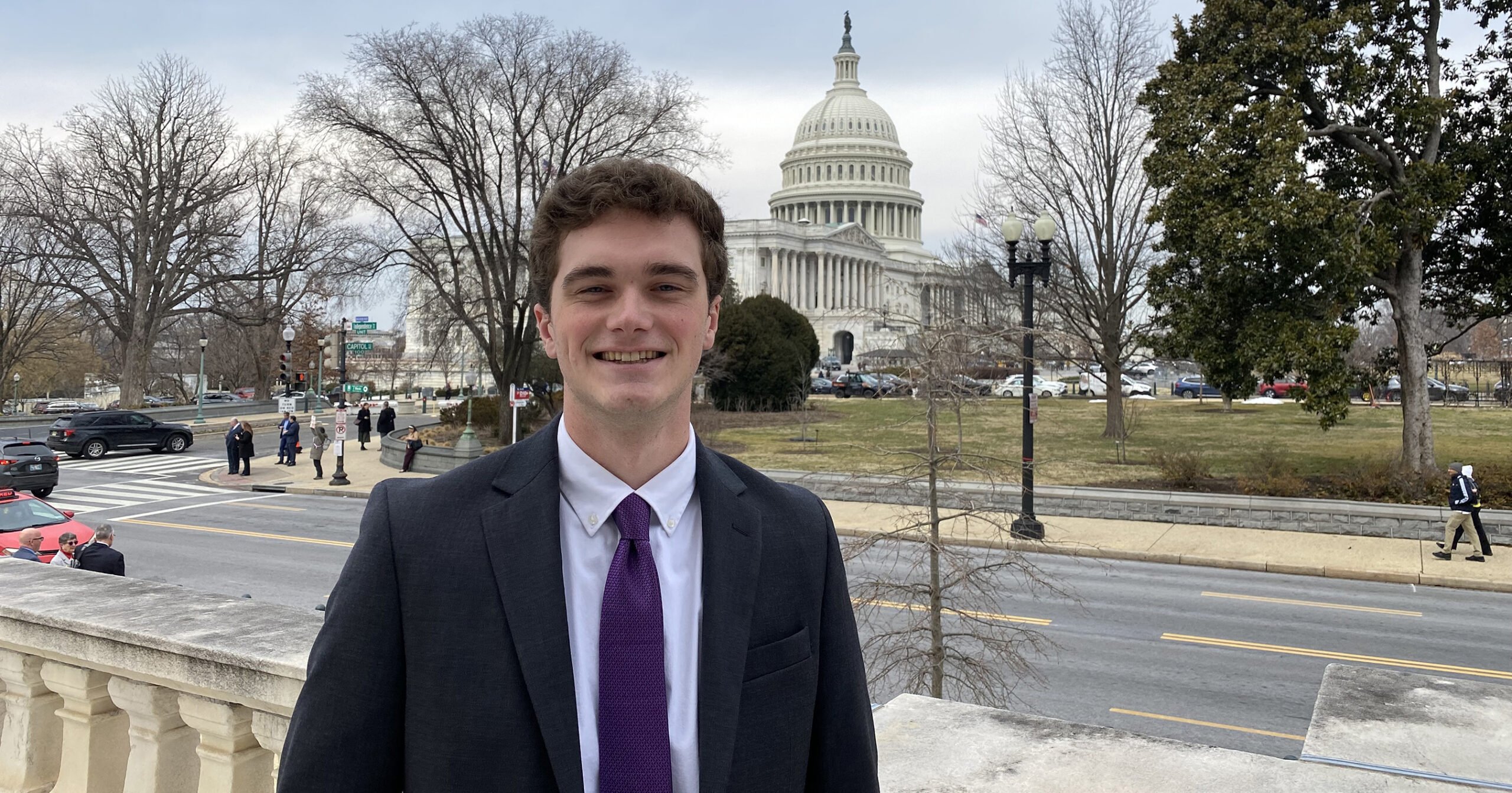
Most days, Duncan McSorley’s graduate studies keep him close to the land – evaluating forage plots, studying cattle grazing habits and seeking answers to questions that matter most to Alabama cattle producers. This semester, however, the second-year master student traded muddy boots and forage samples for marble floors and meeting rooms on Capitol Hill.
McSorley, a master’s student studying ruminant nutrition and forages, was named a recipient of the American Society of Agronomy’s Future Leaders in Science award. Established in 2013, the award provides graduate students with opportunities to advocate for food, agriculture and natural resource research funding at the national level, culminating in a congressional visit day with lawmakers in Washington, D.C.
More than 63 graduate students from across the country applied for the competitive award this year, and McSorley was one of just 10 selected. As a recipient, he participated in specialized training in policy, communications and advocacy before traveling to the nation’s capital. He and other selected students represented a diverse group of states, with McSorley representing Alabama among peers from Arkansas, Georgia, Illinois, Kansas, Louisiana, Michigan, Mississippi, Texas and Virginia.
Leanne Dillard, Alabama Extension forage specialist and associate professor in the Department of Animal Sciences, is McSorley’s major professor. She said his varied experience in crop, soil and animal sciences combined with his leadership abilities made him a standout candidate for the award, describing McSorley’s leadership style as thoughtful and observant.
“He likes to come in, see how things work, and then see how he can make that system more efficient,” Dillard said. “Many, especially young students, think leadership is coming in and being the boss and taking over and having everyone do things the way that you think they should be done. Duncan’s not like that.”
Dillard noted that McSorley’s visit to Washington, D.C. represents a rare and meaningful opportunity for forage research to have a voice in an environment often dominated by other agricultural priorities.
“You know we have a lot of lobbying and work on the cattle side, but there’s not a lot of it on the forage side because we are at the nexus of two different areas,” said Dillard. “So, it’s really a unique opportunity, and I think it also is going to help show how important forage research is and how strong our program is here at Auburn.”
That intersection is exactly what drew McSorley to Auburn University in the first place. Reflecting on his undergraduate studies at North Carolina State University, he explained, “I was minoring in animal science while majoring in agronomy, and forage systems connect both of those.”
From his beginnings at N.C. State, McSorley says each interest he explored led to the next right step that ultimately brought him to Auburn. Central to that journey and a key tenant of Auburn’s land-grant mission was Extension.
McSorley’s maternal grandparents both worked as Extension agents in east Tennessee. His grandfather served as an agriculture agent, while his grandmother served as a home and family agent in their local communities, but they first met at an Extension conference in Arkansas.
“The rest is history,” McSorley joked. “I just think it’s funny — I wouldn’t exist if it weren’t for Extension.”
That connection made his experience in Washington even more meaningful. McSorley described his congressional visits day experience as revitalizing for his career.
“What’s going on at the national level directly impacts everything we do in the agriculture industry, whether it’s at the university level or at the industry level or at the local level, at the state level,” he said. “It all ties back to what’s going on in the USDA or the Farm Bill and how that money is being allocated and what support there is or is not for farmers and for Extension agents. So, I was excited at the opportunity to plug in more in that space and re-energize my career in some ways.”
During his time in D.C., McSorley had the opportunity to meet with staff from the offices of U.S. Senators Katie Britt and Tommy Tuberville, as well as Representatives Robert Aderhold and Dale Strong, who joined in on the meeting himself.
“That was my first time shaking hands with a congressman,” McSorley grinned. “He was very excited about ag research and everything that’s going on in Alabama and at Auburn, and that was really cool.”
McSorley walked away from the three-day visit feeling hopeful about the work being done at the nation’s capital.
“If you watch mainstream media, you spend any time on social media, the prevailing narrative is that our government doesn’t work for us, we have no say in anything, and your Congressional members don’t care about you,’ he said. “That is just not the case. Especially when it comes to our Congress members from Alabama. Their staff members are very plugged into what’s going on in the state. They travel back often, and they’re trying to do the right thing, so that was really reassuring.”
The experience also seemingly sparked a deeper interest in policy engagement for the graduate student who emphasized the importance of agriculture maintaining a strong voice in Washington.
“There are so many ways that we benefit from what’s going on in Washington or potentially don’t benefit if we don’t continue to stay present and have a clear message. I just think that’s paramount, so it’s sort of exciting to have been a little piece of that voice for just a second,” he shared.
McSorley is on track to graduate with his master’s degree in August 2026 and plans to pursue a Ph.D. soon after. Ultimately, he hopes to serve as an Extension specialist in forage systems, helping translate research into practical practices for producers.